
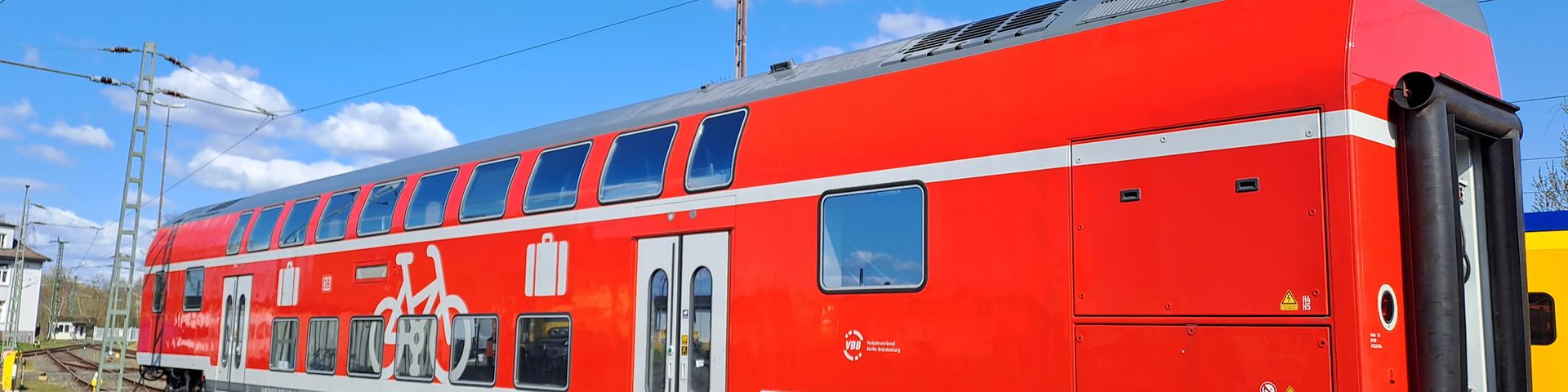
Article: Successful Brake and Slip Tests for Modernized Double-Deck Coaches of Type 752.8
This was made possible, among other things, by reinforced bogies equipped with magnetic track brakes and modified brake pads.
Before the modernized vehicles can enter service, they must obtain a vehicle type authorisation under the Fourth Railway Package from the German Federal Railway Authority (Eisenbahn-Bundesamt, EBA). One of the key prerequisites for obtaining this authorization is the demonstration that the vehicles comply with the braking requirements defined in the relevant regulations and standards.
For this purpose, DB Systemtechnik was commissioned by DB Fahrzeuginstandhaltung Wittenberge to carry out a comprehensive braking assessment.
The assessment comprised both static and dynamic tests, with the latter being conducted on the DB rail network. Since the vehicles had not yet received vehicle type authorization for placing into service at that stage, a special test drive authorization had to be obtained in advance from DB InfraGo and the EBA.
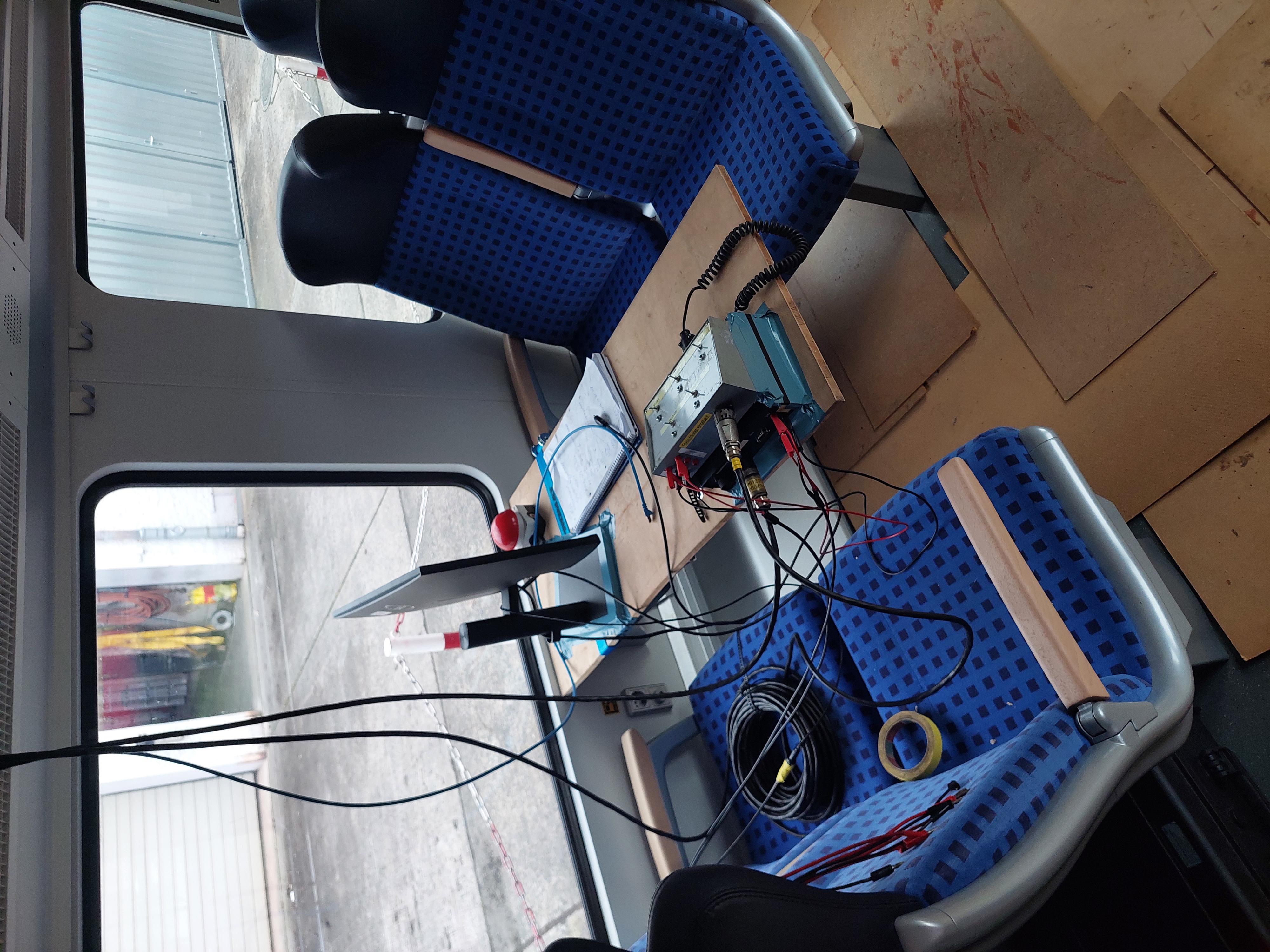
This illustrates the complexity of such a measurement campaign: it combines technical testing, operational planning, safety assessment, and approval support. To successfully deliver the project, several specialist departments within DB Systemtechnik pooled their expertise:
- Determination of the type and scope of evidence required for the authorization for placing into service by our Approval and Engineering experts
- Implementation of the risk management process and subsequent safety assessment by an independent Assessment Body (AsBo)
- Obtaining the required test run authorization and network access through DB Systemtechnik's railway undertaking (RU)
- Execution of the braking assessment by the Brake Testing Department
The coordination of all activities, as well as communication with the customer and all involved stakeholders, was managed by the project management team.
Slip Tests: Evaluating Braking Performance Under Real OperatingConditions
A key element of the measurement campaign consisted of so-called slip tests. These tests are used to determine a vehicle's braking performance under realistic operating conditions.
During the tests, the double-deck coach is intentionally uncoupled from the measurement train at defined speeds up to the target maximum speed of 160 km/h. The measurement train consists of a locomotive, a measurement coach, and the test vehicle positioned at the rear of the train formation.
Once separated from the measurement train at speed, the test vehicle automatically applies full braking force. Installed measurement equipment records relevant parameters such as speed, deceleration, and braking force throughout the braking process.
After the test vehicle has come to a standstill, the measurement train stops, returns to the vehicle, and couples it back into the train formation. The next slip test can then begin.
Once a sufficient number of slip tests have been completed, the recorded measurement data can be used to determine the braking capability of the vehicle. This parameter is of considerable importance for the vehicle's later operation in passenger service.
Wheel Slide Protection Tests – Another Key Element of Braking Assessments
In addition, the performance of the wheel slide protection system was evaluated.
For this purpose, a soap solution is deliberately applied in front of the wheels during braking. This increases the stopping distance compared with braking on a dry rail. The difference between the two stopping distances allows conclusions to be drawn regarding the effectiveness of the wheel slide protection system.
Conclusion
Slip tests are among the most operationally and safety-critical testing procedures in the railway sector. The controlled uncoupling of a test vehicle while in motion requires thorough preparation, precise operational execution, and rigorous safety management. The objective is to minimize risks to people, vehicles, and infrastructure right from the outset.
Interdisciplinary Expertise for Complex Rolling Stock Projects
Through the close collaboration of multiple specialist departments and decades of experience in demanding measurement campaigns, DB Systemtechnik was able to carry out the braking and slip tests safely, efficiently, and as a fully integrated service from a single source.
 Go
Go